 HirePal
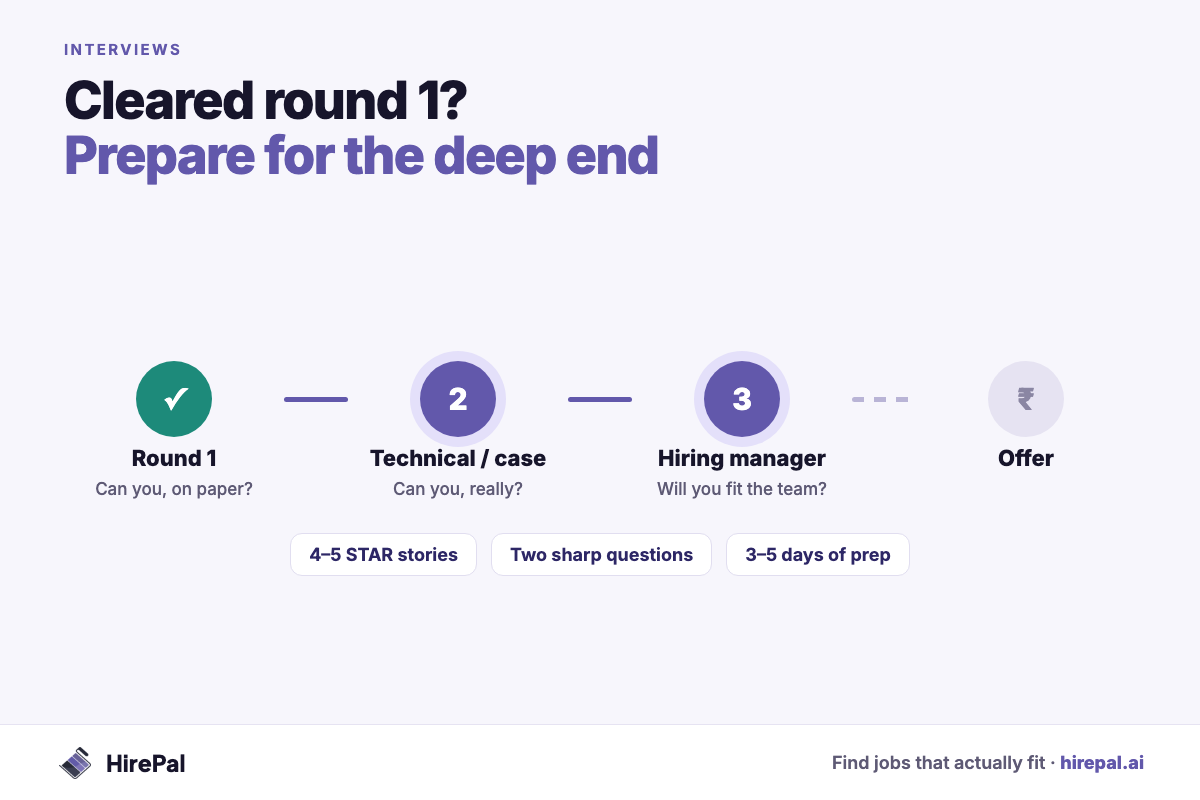
Round one asked “can you do this job on paper?” Round two asks “can you actually do it, and do we want to work with you?”
TL;DR: Second rounds test depth: real skills (technical or case round) and real experience (hiring-manager round). In the days you have, revisit your own work in detail, practise the core skills for the role out loud, prepare four or five STAR stories, research the team’s actual problems, and prepare two sharp questions. Depth and specifics beat breadth and buzzwords.
Clearing the screening call feels great. Then the invite arrives: “Technical round with the team, Thursday” or “Discussion with the hiring manager”. This is usually where shortlists shrink from ten candidates to two or three.
What each later round tests
| Round | What they’re checking | How it often looks |
|---|---|---|
| Technical / skills | Can you do the core work? | Coding, system design, case study, portfolio walkthrough, live task |
| Hiring manager | Have you done it before, and how do you work? | Deep dive into past projects, situational questions, team fit |
| Case / business | Can you structure a messy problem? | Market sizing, a business problem, metrics questions |
| Final / leadership | Motivation, values, long-term fit | Why us, career goals, culture questions |
A 3–5 day preparation plan
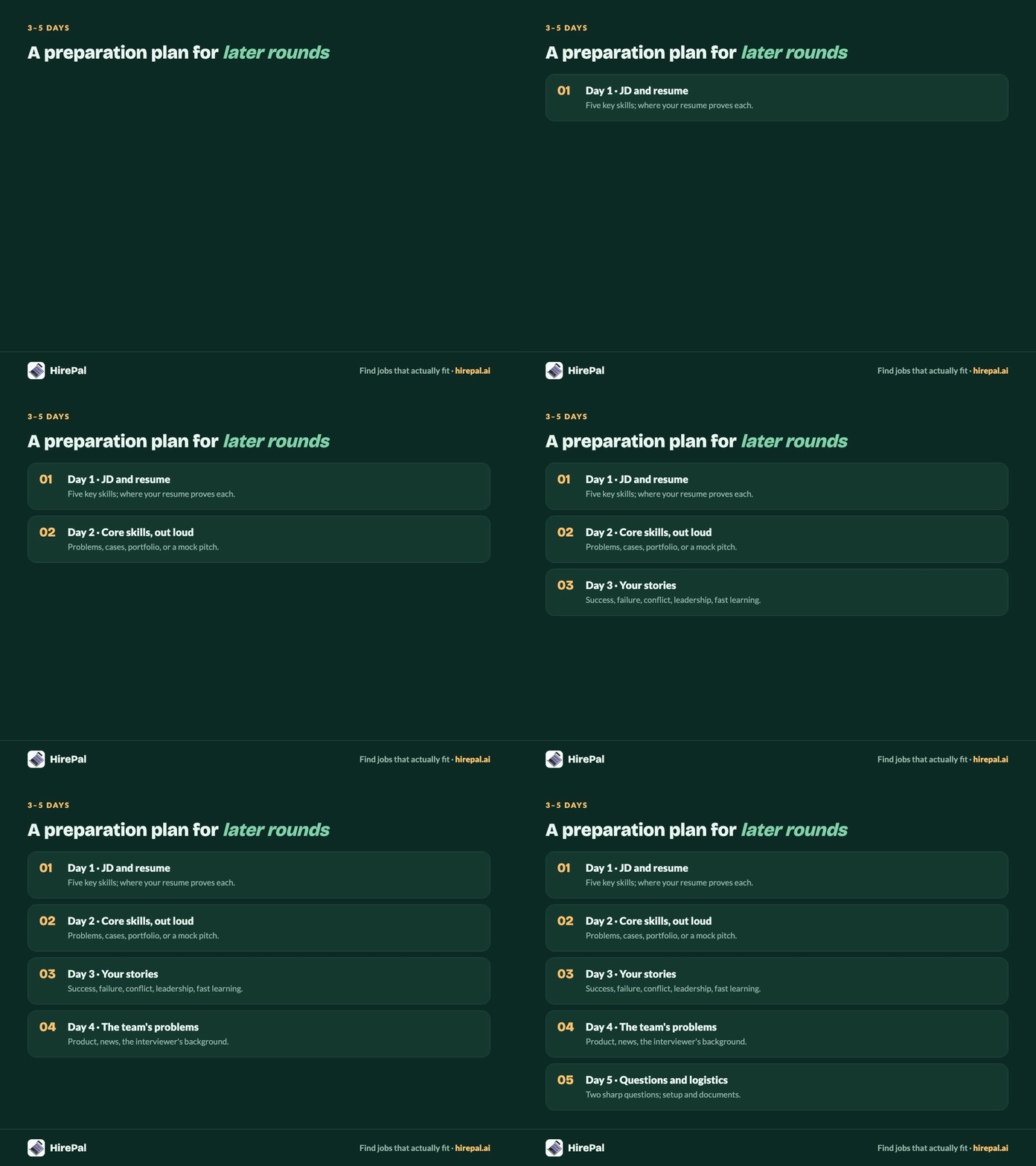
Day 1 — Re-read the job description and your own resume.
List the five most important skills in the JD. For each, find where your resume proves it. Expect deep questions on every line you wrote.
Day 2 — Core skills, out loud.
Engineers: practise problems at the role’s level and explain your thinking aloud. Analysts: SQL, a case, metrics. Designers: walk through two portfolio pieces. Sales: a mock call or pitch.
Day 3 — Your stories.
Prepare four or five stories with the STAR method (situation, task, action, result): a success, a failure, a conflict, a time you led without authority, a time you learned something fast.
Day 4 — The team’s problems.
Use the product, read recent news, check LinkedIn for the interviewer’s background and the team’s work. Prepare one idea or observation.
Day 5 — Questions and logistics.
Prepare two sharp questions. Check timing, link, setup, documents.
Going deep on your own projects
Hiring managers love to pick one project and keep asking “why?”:
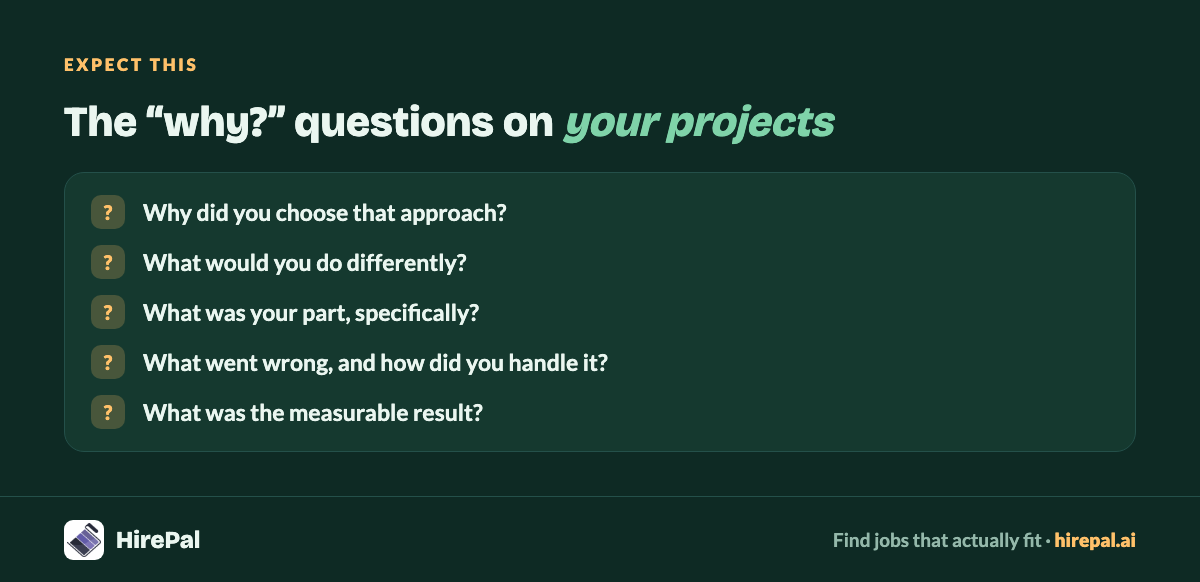
If you can’t answer these for a project on your resume, it’s a liability. Prepare until you can.
Technical rounds: think aloud
- Clarify the problem before solving it.
- Say your approach before coding or calculating.
- Start simple, then improve.
- Test your answer with an example.
- If stuck, say what you’re considering. Silence reads as being lost.
Questions to ask in later rounds
- “What does success look like in this role after six months?”
- “What’s the hardest problem the team is working on right now?”
- “How does the team decide what to work on?”
- “What would make someone struggle in this role?”
After the round
Send a thank-you within a day, mentioning one specific thing you discussed. Note every question in your application tracker; later rounds at other companies often ask similar things.
Get more second rounds worth preparing for
On HirePal, every match explains why the role fits your skills, experience and preferences, which also tells you what the interviewers will probably focus on. Create your free HirePal profile.
Frequently asked questions
Is the second round harder than the first?
Usually yes. It tests depth in skills and real experience, not just fit on paper.
How long should I prepare for a technical round?
Three to five focused days help a lot if your fundamentals are solid. Focus on the role’s core skills, not everything.
Who usually conducts the second round?
Often a team member, a senior engineer or analyst, or the hiring manager, depending on the company.


