 HirePal

Most BGVs are routine. The ones that go wrong almost always involve a small mismatch someone hoped wouldn’t matter.
TL;DR: Background verification (BGV) usually checks your previous employment (dates, title, sometimes CTC and exit status), education, identity and address, criminal records, and sometimes references and credit. It often runs after you accept or join, through a third-party agency, and can take a few days to a few weeks. Be accurate everywhere — dates, titles, CTC — keep your documents ready, and explain anything unusual upfront.
Many Indian companies, especially larger ones, run background checks on new hires. It usually happens quietly through a verification agency. For most people it’s a non-event. For a few, it turns into a withdrawn offer or a difficult conversation after joining.
What’s typically checked
| Check | What they verify | Usually with |
|---|---|---|
| Employment | Dates, designation, sometimes last CTC and reason for leaving, rehire eligibility | Previous employers’ HR |
| Education | Degree, university, year, marks | Universities, boards, digital records |
| Identity | Name, date of birth, ID numbers | Aadhaar, PAN, passport |
| Address | Current and permanent address | Field visit or digital check |
| Criminal records | Court and police records | Databases, local police |
| References | Your work, conduct | Managers or colleagues you named |
| Others (role-dependent) | Credit history, drug test, social media | Finance, security or regulated roles |
When it happens
- Before joining: some companies make the offer conditional on BGV clearing.
- After joining: many run it in the first weeks, with continued employment conditional on it.
- Duration: a few days to several weeks, depending on how quickly previous employers and universities respond.
What commonly goes wrong
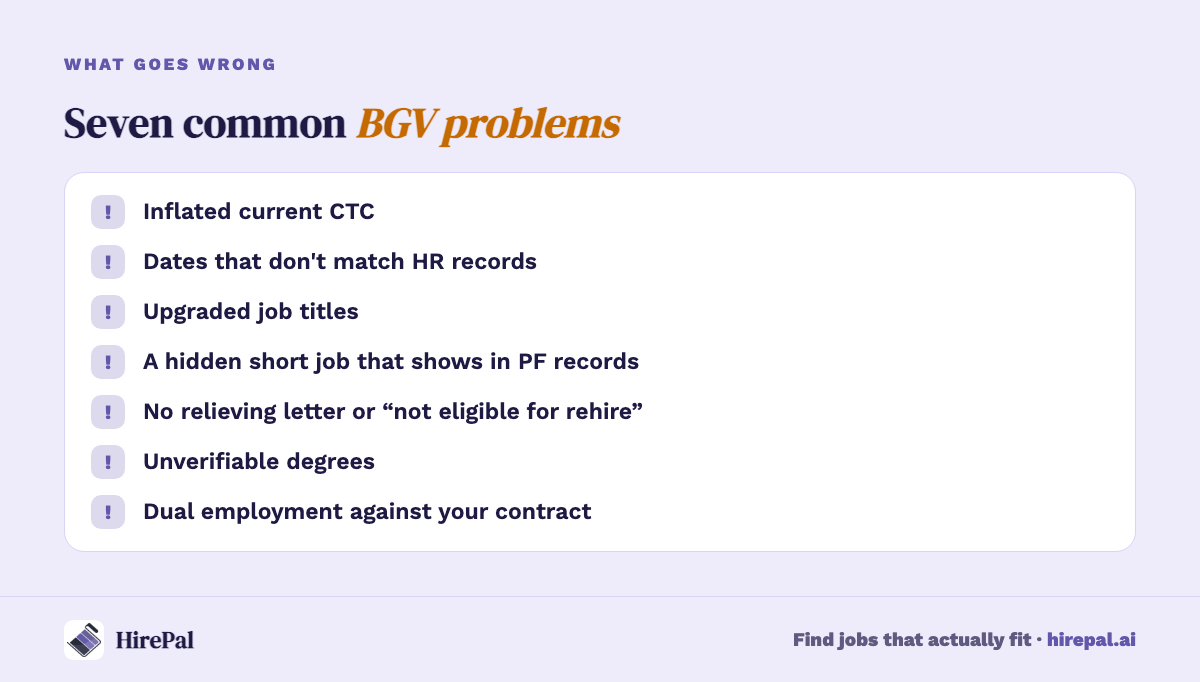
- Inflated CTC. One of the most common issues. If you overstated your last salary, it can surface when payslips or HR records are checked.
- Wrong dates. “Jan 2022 – Dec 2024” on your resume vs “Mar 2022 – Oct 2024” in HR records.
- Title upgrades. “Senior Analyst” on your resume, “Analyst” in records.
- Hidden employment. Leaving out a short job that later shows up in PF records (your UAN shows your employment history).
- Unclean exits. No relieving letter, or “not eligible for rehire” because notice wasn’t served.
- Unverifiable degrees. Qualifications from unrecognised institutions.
- Dual employment (moonlighting) that conflicts with your contract.
Most of these aren’t about lying dramatically. They’re small differences between what you wrote and what records say.
How to prepare
- Make your resume match official records: dates, titles and employers exactly.
- Collect documents now: offer and relieving letters, experience letters, payslips (last 3–6 months), Form 16, mark sheets, degree certificates, ID and address proofs.
- Keep your UAN details handy. PF history is a common cross-check.
- Brief your references before giving their names.
- Disclose unusual things early, like a gap, a short stint, a pending relieving letter or a name change. Explained upfront, they’re usually fine.
If something is flagged
- Stay calm. Agencies sometimes make mistakes too.
- Ask the HR team exactly what was flagged.
- Provide documents that clarify it (an appointment letter, payslips, a university letter).
- Explain honestly and briefly.
Our guide on explaining a career gap in interviews covers how to talk about gaps calmly.
Your rights
BGV should be done with your consent; you’ll usually sign an authorisation form. You can ask what will be checked and how your data will be handled. India’s data protection law gives you rights over your personal data — ask HR how they handle it.
Start honest, stay simple
The easiest BGV is one where your profile was accurate from the first application. On HirePal, your profile’s experience, CTC and notice period are what you’re matched on, so keeping them accurate gets you better-fit roles and a smooth verification later. Create your free HirePal profile.
Frequently asked questions
Do all companies in India do background verification?
Not all, but most large companies and many mid-sized ones do, especially in IT, BFSI and regulated sectors.
Can an offer be withdrawn after BGV?
Yes, if BGV finds significant mismatches or false information. That’s why accuracy matters from the start.
Do companies verify salary during BGV?
Many do, through payslips, previous employers or records. Never inflate your current CTC.


