 HirePal

Silence after applying feels personal. It almost never is. It’s usually one of nine fixable things.
TL;DR: If you’re applying a lot and hearing nothing, the problem is rarely your talent. It’s usually fit (wrong roles), visibility (resume or profile not matching what recruiters search), or timing (applying late). Diagnose which one with the table below, fix that first, and apply to fewer, better-fit roles.
You’ve sent out 80, maybe 100 applications. You’ve had two calls, and one of them was a scam. It’s demoralising, and it makes many people do the worst possible thing: apply to even more jobs, faster.
Before you do, it helps to know what actually happens to an application. For most roles, a recruiter or an applicant tracking system (ATS) sees dozens or hundreds of applicants. They shortlist a handful based on a quick scan: title, experience, key skills, location, notice period and pay. If you miss on two or three of those, you don’t get a “no”. You get nothing.
Here are the nine most common reasons, roughly in order of how often we see them.

1. You’re applying to roles that don’t fit
This is the big one. Applying to a role that needs 5–8 years when you have 2, or a Pune on-site role when you need remote, or a ₹10 LPA budget when you expect ₹18 LPA, gets filtered out almost instantly.
Fix: before applying, check the five things that decide shortlisting: role, experience, location, pay and notice period. If two don’t match, skip it. Our guide on how to get a job in India shows how to write these down once and use them as a filter.
2. Your resume doesn’t use the job’s words
Recruiters search for the exact skills in their job description. If the job says “channel sales” and your resume says “dealer management”, or it says “React” and yours only says “frontend”, you may not show up at all.
Fix: tailor your summary and top bullets to each role you really want, using the job’s own words where they’re true. GoResume’s 10-minute tailoring method shows how.
3. Your resume lists duties, not results
“Responsible for sales in assigned area” tells a recruiter nothing they didn’t already know. “Grew territory sales 18% in FY25 by adding 40 dealers” makes them want to call you.
Fix: rewrite your top three bullets as action + what you did + result. GoResume’s guide to writing work experience has before-and-after examples.
4. Your profile is stale or incomplete
On Naukri and LinkedIn, recruiters search profiles, not just applications. A profile with an old CTC, a 90-day notice period you’ve since shortened, or no key skills won’t appear in their searches.
Fix: update your headline, key skills, current CTC, expected CTC and notice period. Then make a small edit every week so you stay recent.
5. You’re applying too late
Many listings get most of their applications in the first few days. By week three, the recruiter may already be interviewing a shortlist.
Fix: turn on narrow alerts and apply within a day or two of a posting. A good application on day 2 beats a perfect one on day 20.
6. Your notice period or CTC filters you out
In India, these two numbers decide many shortlists before anyone reads your experience. A 90-day notice period rules you out of “immediate joiner” roles. An expected CTC far above the budget rules you out quietly.
Fix: be honest, but be strategic. If your notice period is negotiable, say so. If you’re open to a range, give a range. We’ll cover notice periods and expected CTC answers in detail this month.
7. Your resume breaks in the ATS
Tables, text inside images, two-column layouts and unusual fonts can scramble how software reads your resume. A recruiter may see your experience in the wrong order, or not at all.
Fix: use a simple, single-column layout with standard headings. GoResume’s guide to ATS-friendly resumes explains what the software actually reads.
8. You’re only using the job portal’s “Apply” button
Mass-applying through portals is the lowest-response channel. Referrals and direct contact with the hiring team convert much better.
Fix: for every role you really want, try one human route: a referral, a message to the hiring manager, or an application on the company’s own careers page. See our comparison of job sites in India for which channels suit you.
9. The role was never really open (or already filled)
Some listings stay up after a role is filled, are posted for compliance, or are “evergreen” listings collecting resumes. Some are scams. None of these are your fault.
Fix: prefer recent listings, check the company’s careers page, and never pay a fee to anyone for a job.
Diagnose yours in two minutes
Look at your last 30 applications and find your pattern:
| What’s happening | Most likely cause | Fix first |
|---|---|---|
| No calls at all, anywhere | Resume or ATS problem (reasons 2, 3, 7) | Rewrite and simplify your resume |
| Calls from recruiters, then silence | CTC or notice mismatch (reason 6) | Re-check your numbers and how you say them |
| Calls only for roles below your level | Profile undersells you (reasons 3, 4) | Rewrite bullets with results; update your headline |
| Calls only for the wrong kind of role | Profile is unclear (reason 4) | Make your title and skills say what you want next |
| Calls, then interviews, then no offers | Not a resume problem | Work on interviews (more on this blog soon) |
What “fewer, better applications” looks like
Here’s the shift that matters most. Instead of 100 random applications a month, aim for 20 to 30 that genuinely fit, each with a tailored summary, sent early, and with one human follow-up.
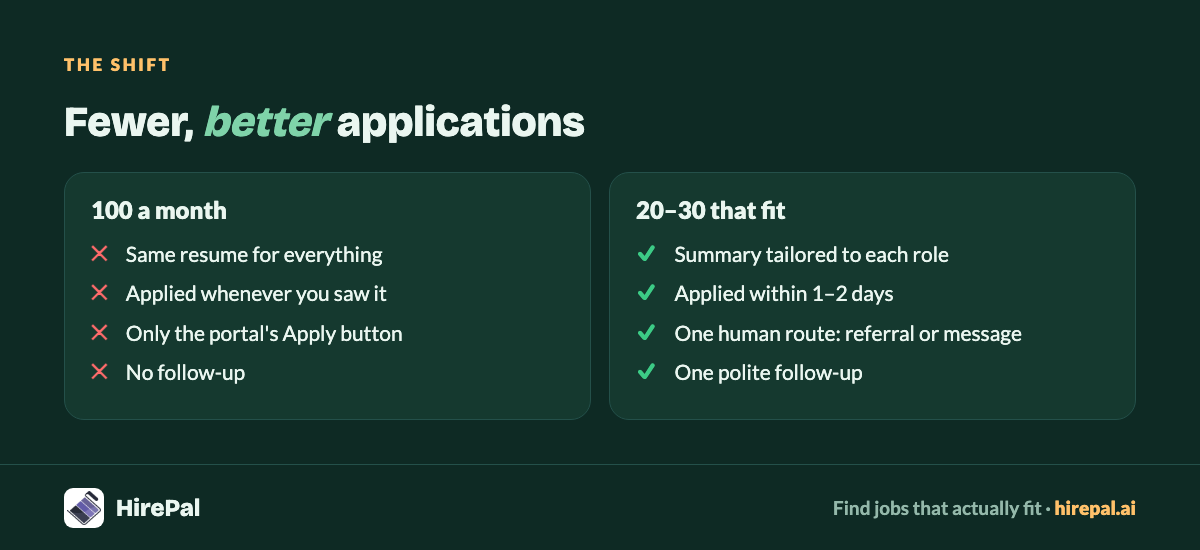
It feels slower. It usually works faster.
How HirePal helps with the fit problem
Reason 1 is the one that wastes the most time, and it’s why we built HirePal. You set your role, specialisation, experience, location and pay once. Every job is scored against them and labelled, from strong to poor matches, with a plain-language “why this job is a match” that’s honest about gaps like pay.

So instead of guessing which of 100 listings might fit, you start with the ones that do. Create your free HirePal profile and see your best-fit roles.
Frequently asked questions
Why am I not getting interview calls even though I’m qualified?
Usually because the recruiter can’t see that you’re qualified in a quick scan. Your resume may not use the job’s keywords, may list duties instead of results, or your CTC, notice period or location may not match the role.
How many applications does it take to get an interview?
It varies widely by field and level. Instead of chasing a number, track your response rate. If it’s very low, change what you’re sending and where, not how much.
Should I apply again to the same company?
Yes, for a different role that fits better, or after a few months for the same role if you’ve improved your profile. Don’t re-apply to the same listing repeatedly.
Do recruiters reply to every application?
Many don’t, especially on high-volume listings. Silence usually means you weren’t shortlisted, not that you were judged harshly.


