 HirePal
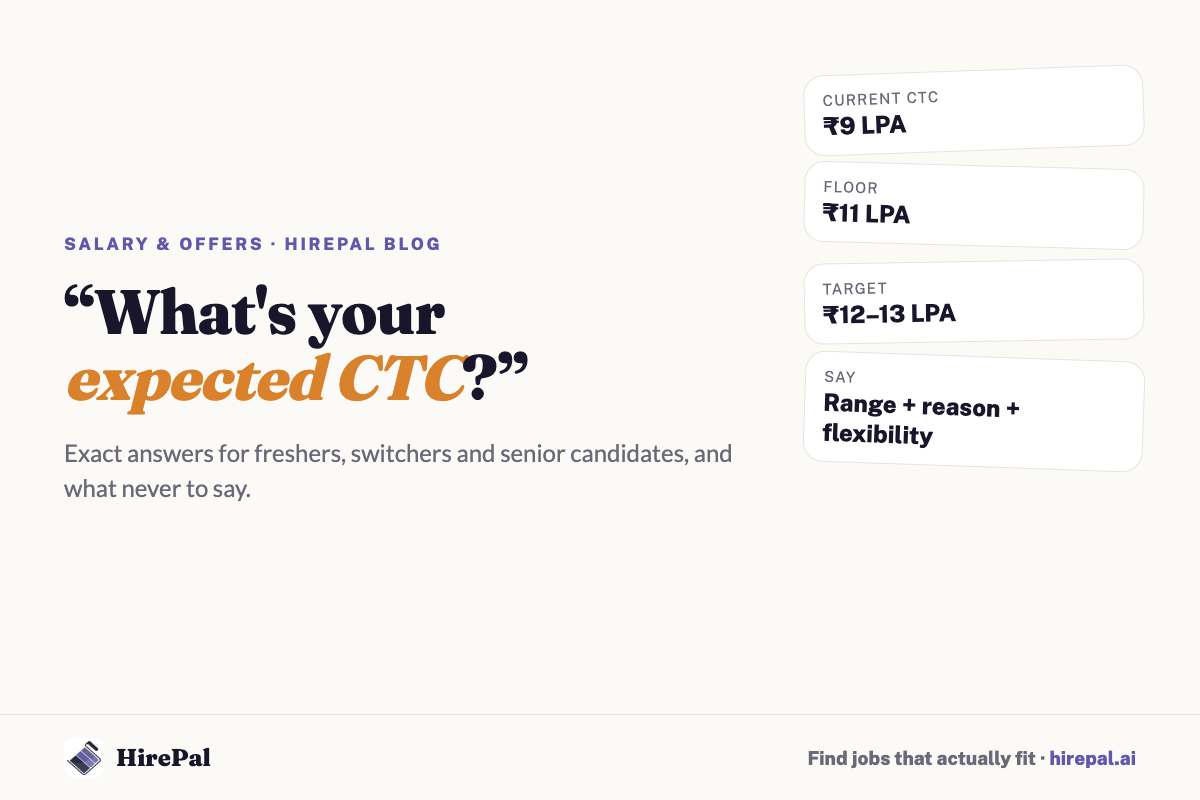
The most common HR question in India is also the one most people answer worst. Here’s how to say a number with confidence.
TL;DR: Research the market range for the role, decide your floor (the lowest you’d accept, in in-hand terms) and your target, then give a range that starts near your target, with one reason and a note of flexibility. Freshers can defer to the company’s standard offer. Never give a number you can’t explain, and never lie about your current CTC.
“What’s your expected CTC?” usually arrives in the first recruiter call, before you know much about the role. Say too low and you leave money on the table for years. Say too high without a reason and you’re quietly dropped.
The good news: this question has a reliable structure, and once you’ve prepared it, it takes 15 seconds to answer well.
Step 1: Know your three numbers
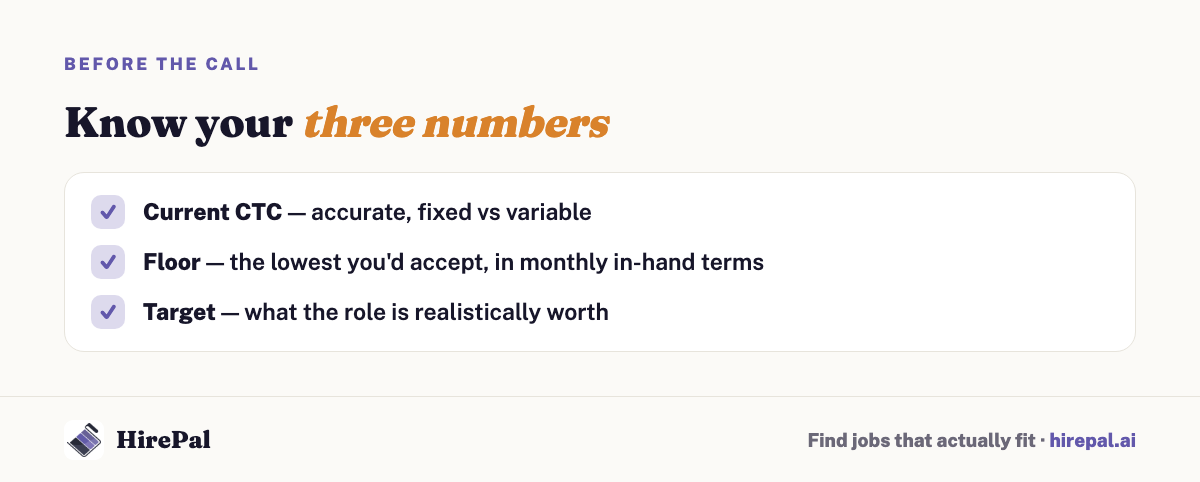
Before any HR call, write down:
- Your current CTC — accurately, with the fixed/variable split. It may be verified with payslips.
- Your floor — the lowest CTC you’d accept. Work it out in monthly in-hand terms first; our guide to CTC vs in-hand salary shows the maths.
- Your target — what the role is realistically worth for someone with your experience.
Step 2: Research the market
- Job listings with pay ranges for similar roles and experience in your city.
- Salary sites like Glassdoor and AmbitionBox, read as rough ranges, not exact truth.
- People in the role: friends, alumni, ex-colleagues. One honest conversation beats ten websites.
- Recruiters: ask them the budget. Many will tell you.
Step 3: Answer with a range, a reason and flexibility
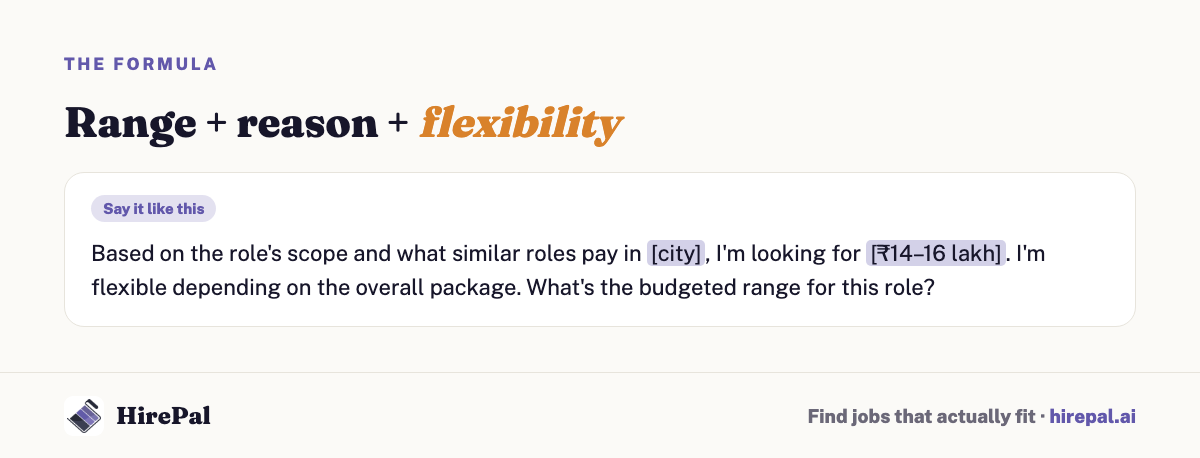
The formula: range + reason + flexibility (+ a question back).
“Based on the role’s scope and what similar roles pay in Bengaluru, I’m looking for ₹14–16 lakh. I’m flexible depending on the overall package. What’s the budgeted range for this role?”
Why it works: the range starts near your target, the reason shows you’ve done homework, and the question invites them to share the budget.
Sample answers
Fresher:
“As a fresher, I’m open to your standard offer for this role. I’d love to understand the compensation structure.”
If pushed: “I understand roles like this typically offer ₹4–6 lakh. I’m comfortable within that range.”
Switcher (2–5 years):
“I’m currently at ₹9 lakh. For this role, given the added responsibility for [X], I’m looking for ₹12–13 lakh.”
Senior or niche skills:
“For a role at this level, with [team size / ownership / niche skill], I’m looking at ₹30–34 lakh fixed. I’m open to discussing how variable pay and equity fit in.”
Changing careers (taking a step back):
“I’m moving into product from operations, so I’m flexible on the number. I’d expect something around ₹10–12 lakh, close to my current pay.”
If you’re between jobs:
“My last CTC was ₹11 lakh. For this role I’m looking for ₹12–13 lakh, and I can join immediately.”
What not to say
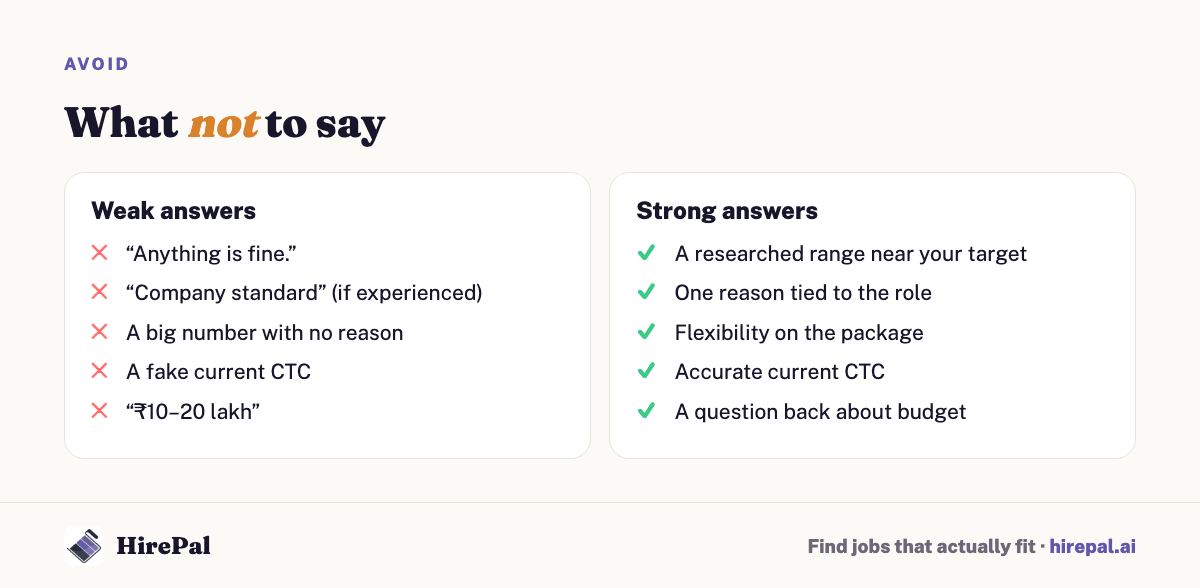
- “Anything is fine.” It signals you don’t value yourself, and the offer will reflect that.
- “Whatever is the company’s standard.” Fine for freshers, weak for experienced candidates.
- A number with no reason, especially a big jump.
- A fake current CTC. It’s often verified in background checks, and offers have been withdrawn over it.
- A range so wide it means nothing (“₹10–20 lakh”).
“That’s above our budget.” What now?
- Ask for the range: “Could you share what’s budgeted?”
- Separate fixed from total: maybe variable pay, joining bonus or a faster review closes the gap.
- Decide against your floor, not your pride. If the best they can do is above your floor and the role is right, it may still be a good move.
- Ask about a review: “Could we revisit compensation after six months, based on performance?” Get it in writing if they agree.
How a fair range follows you into the offer
Your expected CTC anchors the negotiation that happens when the offer arrives. A well-researched range in the first call makes the final conversation much easier.
On HirePal, you set your expected pay as a preference, every role’s pay range is shown up front, and your match explains when a company’s budget may be below what you want. So fewer calls end with “that’s outside our budget”. Set your pay preferences on HirePal.
Frequently asked questions
How much hike should I ask for when switching jobs?
It depends on your role, skills and market. Base your ask on the market range for the new role, not on a fixed percentage over your current pay.
Should I tell my current CTC?
Yes, accurately. Many companies verify it. You can add context, like an upcoming increment or a variable payout.
Can I change my expected CTC later in the process?
You can, if the role turns out bigger than described. Explain why. Changing it without reason late in the process hurts trust.


